#21: HELLHOLE!
we talk about satan in the suburbs, housing hell and cursed conurbations

Welcome to the twenty-first ever edition of Every Other Bee, a digest of poetry which, each edition, is designed around a different theme. This week, it’s a sojourn into suburbia.
Part I: Travelogue
One of the ongoing themes of my life (and this newsletter) is that I am not from one specific place. I grew up between London (big big city) and Brisbane (the suburbs), then moved to The Hague (small big city), then kind of moved back to London (big big city), then travelled around this summer.
Since March 2022, I have visited (in order of appearance, grouping trip destinations together and removing London, which I return to as my base): The Hague, The Netherlands; Miami and New York City, United States; Dublin, Ireland; Brisbane and Melbourne, Australia; Amsterdam, The Netherlands; Brighton, United Kingdom; Paris, Antibes, Cannes, Nice, Juan-les-pins, Mandelieu-la-Napoule, Théoule-sur-mer, Villefranche-sur-mer, Beaulieu-sur-mer, Saint-Jean-Cap-Ferrat, Roquebrune-Cap-Martin, Menton (all France), Monte Carlo, Monaco, Portofino, Monterosso, Vernazza, Corniglia, Manarola, Riomaggiore and Florence, Italy; Cambridge, United Kingdom; Little Silver, Wildwood, Cape May, New York City (again), Philadelphia and Los Angeles, all United States, and Vancouver, Calgary, Banff and Lake Louise, Canada. There’s big big cities in there, small big cities, small towns, villages, and wilderness.
I’ve gone from some of the most densely populated parts of the world to teeny towns of a few streets to villages set into mountains and coastlines which go on forever. I’ve been to tourist traps bursting with people sporting ugly Tevas and even uglier accents to places that only people who live there know about.
All of this is to say: I think I know more about places now than I ever have before. And I think how I feel about suburbs finally makes sense to me because I’ve returned to the one I spent part of my childhood in, having now been many other places and I feel the vestigial fondness of nostalgia. This is, of course, despite the fact that every single person online whose job it is to do content about how they’re a millennial has huge suburban energy (derogatory): they all seem to drive cars, spend $7 daily on a giant blended Frappuccino from Starbucks and have absurd closet space. (Parenthetically, I am constantly stunned by how many pairs of shoes other people (mainly Americans) own. I own six, including my pair of slippers for around the house.) But now, when I think of the suburbs, I don’t just think of anonymous people: I think fondly of my mother (and her sprawling garden and her swimming pool), of my sister (and her big air-conditioned car and multi-bedroom home), of my cousins, of my friends, of all these dear little corners of my heart.
I also now think of what I can only describe as the #JerseyStrong corner of my heart. I had a wonderful time this summer in New Jersey staying with my uncle in a small town in the suburbs of New York. (I note here that New Jersey is the Switzerland of the United States, but rather than French, German and Italian cantons, it has New York, Philadelphia and beach cantons. It is defined by what abuts it, by what overshadows it. Even miles from the city, my uncle’s town is a suburb of it.)
I loved so many parts of his small town: the majesty of the old Masonic lodge, the huge supermarket, the deer who wandered through his garden one morning.
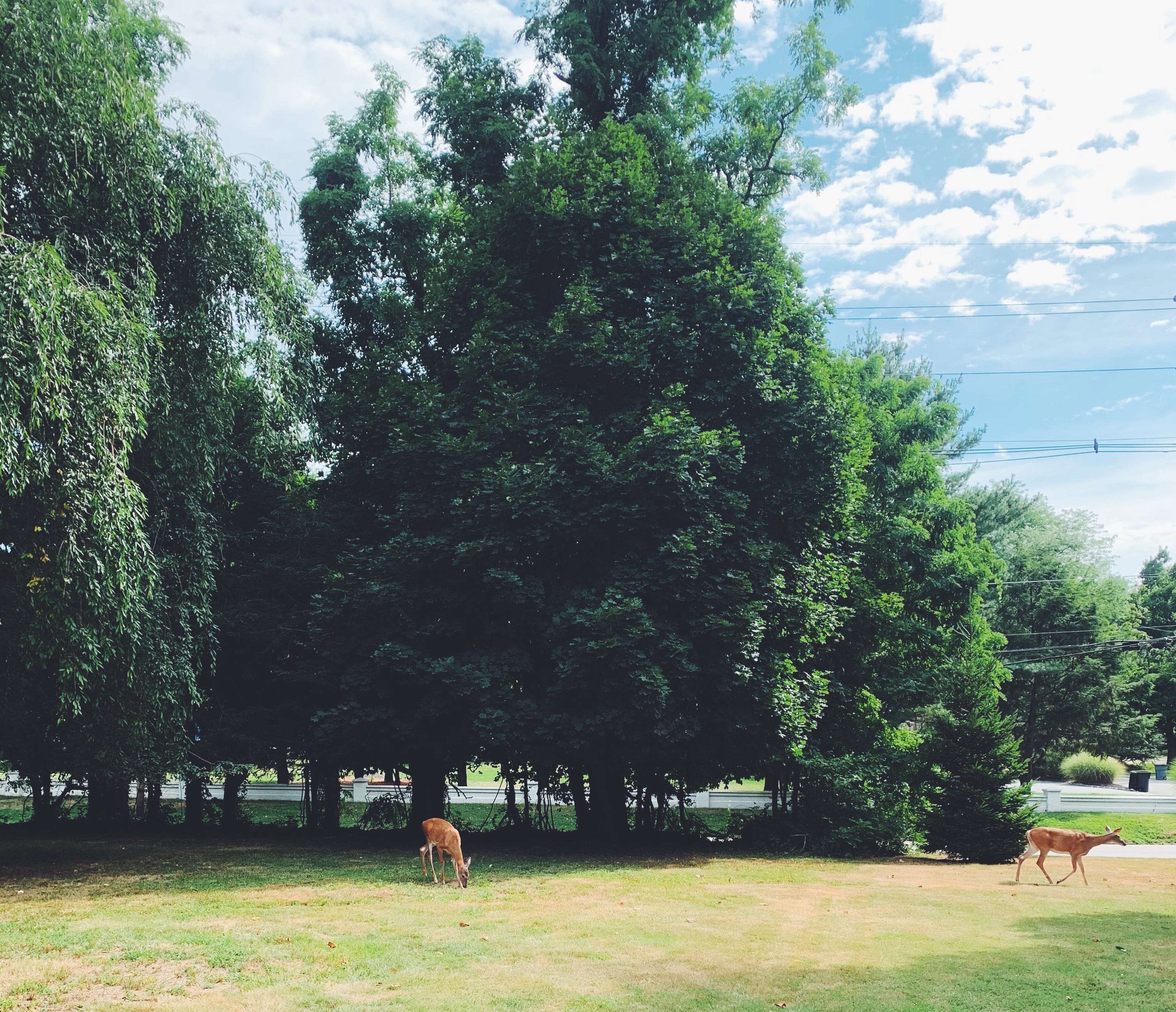
But I have never, in my life, felt more trapped. If I want to go on a walk in London, for example, where I am currently writing this, no-one will bat an eyelid. Ditto in small villages. The idea of independent motion seemed to be so foreign to my uncle. He is a wonderful man and the time we spent together was astonishingly special, but it was as if he assumed that one would only go for a walk because one didn’t have a car or didn’t want to inconvenience a driver rather than going for a walk for its own sake. This is a fairly normal experience: after all, there’s a Tweet about this I was reading this morning: ‘My parents having to DRIVE to go for a walk in their town is one of the greatest ironies of suburban living.’
Horace Gregory’s Interior: The Suburbs (1930) is a sensational reckoning of suburban claustrophobia: ‘There is no rest for the mind / in a small house. […] The mind, sunk in quiet places, / (like old heroes) sleeps no more, / […] There is no rest— / for there are many miles to walk in the small house, / traveling past the same chairs, the same tables, / the same glassy portraits on the walls, / flowing into darkness.’ Bill Manhire writes in Christmas (2014): ‘Evening: the nervous suburbs levitate.’ Even though I loved it in New Jersey, I felt this desperation keenly; I was at once sunken and levitating, restless and hopelessly still.
Part II: Hellhole
The suburbs are such a weird place. They shouldn’t exist. They’re ideologically evil: based in racism, ecologically disastrous and straight up inconvenient to live in. The fact that they are, and have always been, a place of untold cruelty is demonstrated by the fact that the news was aflame this week with a story about a New Jersey town which removed all the trees in its town square to clear out its unhoused population. We think about a lot of hostile architecture as being purely a city thing: think of all the bad benches you’ve seen, the lack of public toilets, the proliferation of rubbish on city streets. The thing about hostile architecture is, of course, that it’s hostile to everyone. No-one benefits from not having anywhere to sit, or pee, or simply exist in public without having to pay money. If there’s something which sums up modern living, it is cutting off your nose to spite your face. But hearing about it in a suburban, small town setting was different. It captured, honestly, their cruelty.
A lot of people hate the suburbs. Stevie Smith’s The Suburban Classes (1972) is a fairly (unfairly?) withering portrait of suburbanites: ‘There is far too much of the suburban classes / Spiritually not geographically speaking. They’re asses. / Menacing the greatness of our beloved England, they lie / Propagating their kind in an eightroomed stye.’ Eavan Boland’s Ode to Suburbia (1996) revels in its hideousness: ‘Six o'clock: the kitchen bulbs which blister / Your dark, your housewives starting to nose / Out each other's day, the claustrophobia / Of your back gardens varicose / With shrubs, make an ugly sister / Of you suburbia.’
Suburbs are all about conformity. As mentioned, they began as a racist invention: white flight against Black people’s existence in cities and towns. They still have that at their core: home-owners’ associations issuing fines, house prices designed to keep certain groups out, a reactionary black hole into which disappears any hope of a better world. Michael Blumenthal’s Suburban (1987) talks about this: ‘Conformity caught here, nobody catches it, / Lawns groomed in prose, with hardly a stutter.’ David Roderick writes about in Dear Suburb (2009): ‘That need, / that scared need to whiten / or clean a surface: plywood or lawn,’ this reactionary need to whitewash and scour down.
Elise Paschen’s Lear’s Wife (2016) describes the gendered aspects of this underworld: ‘He faked my death, / set up this ranch / far from my three / daughters. / Suburban / hellhole. With bracelet / on ankle, house- / arrest.’ Stephen Dunn’s Sisyphus in the Suburbs (2003) similarly places its mythical protagonist into the suburbs, showing the meaninglessness of its surroundings: ‘Tomorrow he’d brave the cold, / spireless mall, look for a gift. / He’d walk through the unappeasable / crowds as if some right thing / were findable and might be bestowed.’
Vahni Capildeo’s To London (2016) is a poem I think of whenever I walk at night, specifically this line: ‘The night light fucks the suburb / into nightmare familiarity’. There’s a clarity which sometimes only curse words can achieve. Suburbs are places of nightmare, places of death: Tommye Blount’s The Tongue (2015) is an astonishingly well-written poem and one of its best metaphors is this one: ‘Anyway ... Every other word, / the woman slips into English. / The way a train window / trades a dead city for a dead suburb’. After all, death in the suburbs is brutal and small: it’s like all those people who die choking in steakhouse bathrooms because they’re too embarrassed. In Michelle Boisseau’s Death Gets into the Suburbs (2012), she talks about this: ‘There’s death by taxi, by blood clot, by slippery rug. / Death by oops and flood, by drone and gun. / Death with honor derides death without.’
Part III: Endearments
And yet, and yet, and yet, there’s something romantic here: David Roderick’s Dear Suburb (2009) is glorious and kind and generous: ‘I’m not interested in sadness, / just a yard as elder earth, / a library of sunflowers / battered by the night’s rain. / When sliced wide, halved at dawn, / I can see how you exist, / O satellite town, your bright possibility / born again in drywall / and the diary with the trick lock. / Hardly held, for years I slept with my window wide open, / wanting screen-cut threads of rain.’
Sjohnna McCray’s Burning Down Suburbia (2016) is about a childhood love for Bob Ross and his painting, but it shows that same artistic flourish for suburbia: ‘To be soothed by his voice and taken, / lured from the dining-room table and shown / the suburb's majesty. Look son, he might say, / at the pile of autumn leaves, the shade / on that forest-green trash bag. Using his two-inch brush / he'd blend the prefab homes on the hill / until they seemed mysterious, folded hues / of Prussian blue, Van Dyke brown, and a blaze of alizarin crimson.’
Think about how many paintings there are of Paris, or New York City, or London, or Venice, and then think about how there are so few of the endless repetition of suburban housing, of gardens all in a row, of Columbus Ohio. There was a TikTok trend which surfaced on Twitter and Instagram (apps which, unlike TikTok, I am willing to access) using a racist country music star’s song about not being able to love a girl more than his hometown and there was sheer joy in watching girls name random towns and cities in New Jersey, Michigan, Ohio, the joke being that it would be impossible that someone was not able to love a girl more than that font of mediocrity.
Rachel Sherwood’s The World in the Evening (1981) captures the weirdness of the suburbs, which is most strongly observed at night: ‘As this suburban summer wanders toward dark / cats watch from their driveways — they are bored / and await miracles. The houses show, through windows / flashes of knife and fork, the blue light / of televisions, inconsequential fights / between wife and husband in the guest bathroom / voices sound like echoes in these streets / the chattering of awful boys as they plot / behind the juniper and ivy, miniature guerillas / that mimic the ancient news of the world / and shout threats, piped high across mock fences / to girls riding by in the last pieces of light’.
For my part, I remember when I would return as a child to Brisbane after being in London and while walking at night, the sheer silence of the streets would strike deep into my soul. Surely it was impossible, I thought, that no-one is walking down this street, that no-one’s light is still on, that every shop and restaurant is already closed. But that is the mystery of life, the mystery of the suburb. The owls are not what they seem; everything under the sun is possible in the dark nightmare of the suburban hellhole.
Join me next time for an odyssey into oxymorons. In the meantime, if you haven’t liked this post (or even if you have), you may contact me at everyotherbee@gmail.com.